
Will agentic ecommerce reinforce monopolies ?
In September 2025, OpenAI and Shopify announced a partnership through which customers can directly purchase stuff from within the ChatGPT interface.
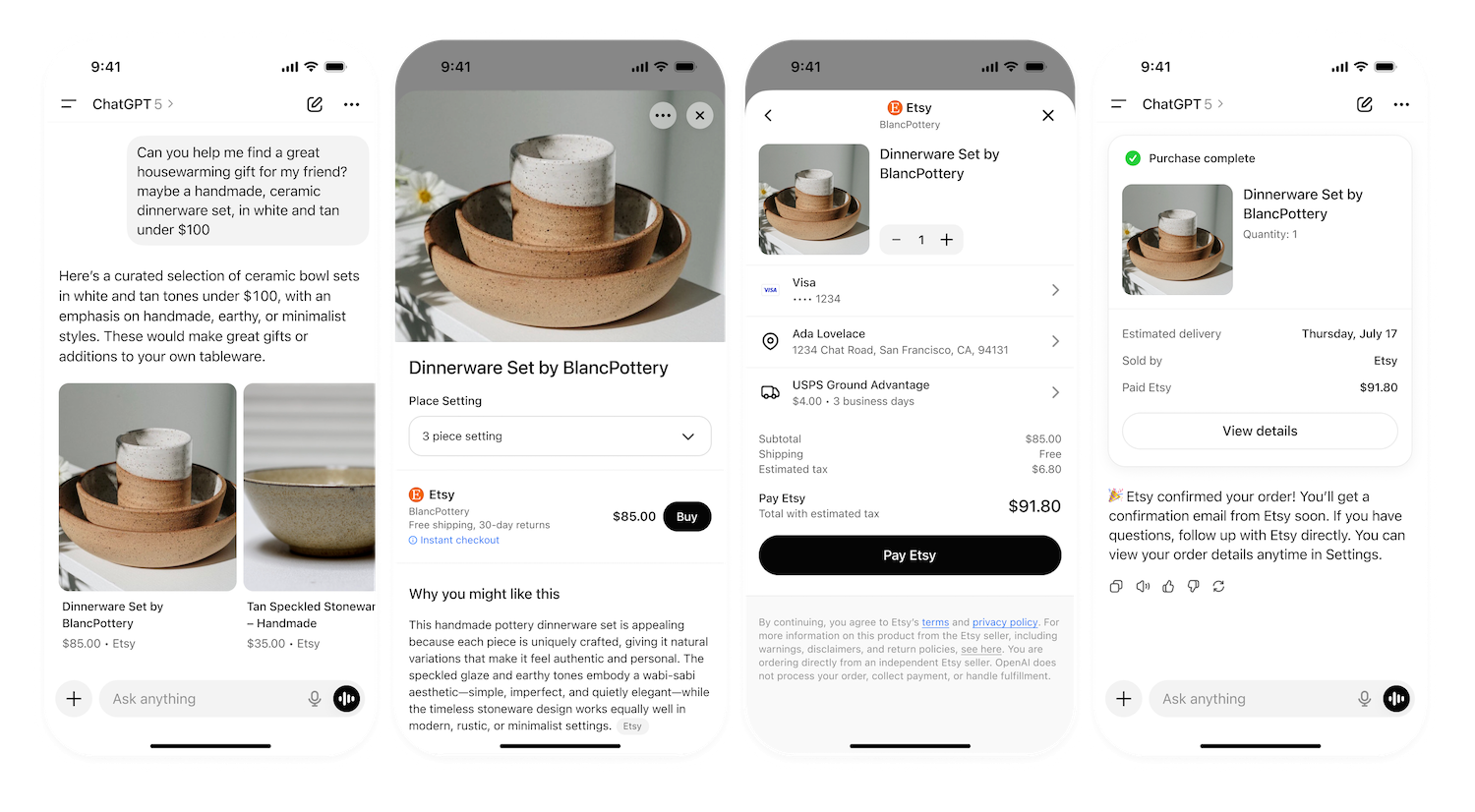
The vision is in fact makes sense. Directly buy from chatgpt prompt where you are anyway lurking the whole day ! ChatGPT can help you save the time wasted on the dozens of horribly made e-commerce websites. Remains to be seen if this really works, however even giants like Amazon seem to getting worried . This all looks very convenient for users but lets look at the concerns here
GateKeeper for Products / Shops
The AI websites can choose at whim which products to highlight and which to not show. This gives them immense leverage to negotiate deals with big ecommerce stores. SME shops will have difficult time getting customers as more users directly use AI instead of using search / websites
Closed ecosystem of Payment Methods/Partners
There are currently two major agentic commerce protocols - Agentic Commerce Protocol (OpenAI) and Agentic Payment Protocol (Google/Industry Coalltion). ACP only support Stripe/Credit cards. AP2 is more open and has a list of payment methods including authorize.net, google pay, airwallex, metamask (complete list is available here ) . The AI engine can delist / add payment partner at their will. This is unlike something like Woocommerce/Wordpress where the merchant can accept payment methods upto his discretion.
Privacy - shopping behaviour database
AI engine will store each user's shopping behaviour through time. This helps them to give personalize recommendation for products. Truth be told - majority of users don't really care about the privacy of their shopping lists as long as they are getting discounts ! However, privacy is starting to be taken seriously. A recent survey shows approximately 42% to 47% of U.S. adults use a VPN.
AI is projected to capture a substantial share of the e-commerce market, with specific forecasts estimating that AI-powered "agentic shoppers"—autonomous personal assistants—could capture 10% to 20% of all U.S. e-commerce market share by 2030, representing up to $385 billion in spending (Source: morganstanley)
Way ahead for SMEs
This poses a difficult question. What should be the stratergy of SMEs in the age of agentic commerce? Millions of ecommerce websites are selling fashion, apparels, domain names, music and other products. These website owners have spent countless hours optimizing their websites and products to be relevant and competitive to their consumers
- Websites and UI is still revelant - AI is an incremental channel rather than replacing how people shop. People still like going to shopping malls even after 20+ years of online shopping. Clean and seamless website navigation will still help attract customers.
- Adopt open agentic ecommerce protocols - Website owners must implement open agentic ecommerce protocols to help AI engines/agents enable discovery. Publishers have tried to block AI bots or make them pay to crawl. However, both these approaches have been unsuccessful. By adopting open agentic commerce, businesses can retain their independence while tapping into new channels of customers.
- Customer support and human interaction - Excellent and personalized customer service is essential to build brand loyalty and word of mouth. The entreprise push for AI chatbots has backfired. Majority of customer prefer to get personalized help from a real person.
- SEO / Marketing rehaul - In the age of AI, marketing efforts need to be reimagined. Spending thousand of dollars getting SEO backlinks or optimizing website keywords would likely yield zero results. AI engines are hungry for original content and thoughts. Efforts in this direction would be more beneficial.
To conclude, agentic ecommerce is evolving and has potential to proliferate the dominance of Google, OpenAI etc. Business owners must upgrade and evolve and to retain their autonomy / marketshare
Comments ()