
How VPS Hosting Merchants Can Accept USDT Payments in Minutes
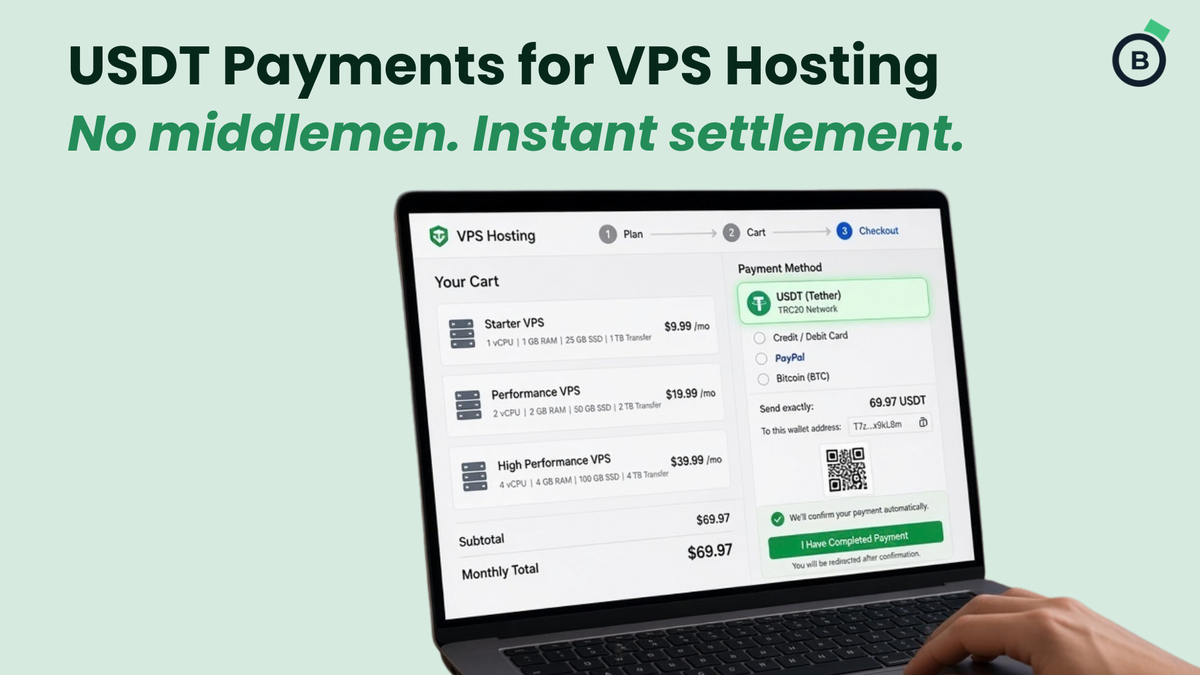
End customers are already typing “VPS hosting USDT,” “pay for VPS with Tether,” and “crypto VPS no KYC” into search engines every day. The merchants who answer that demand cleanly win the order, and often keep the customer longer.
Here is something you will not find in the usual processor marketing pages: the real operational win comes from pairing non-custodial payments with a short confirmation buffer in your own automation.
On Ethereum (the network Blockonomics currently uses for USDT), one or two confirmations are usually enough for low-value invoices. For higher-value VPS plans, many experienced merchants wait for three to six confirmations plus a small internal delay before triggering the provisioning script. This almost completely eliminates the rare but painful edge cases around chain reorganizations or late double-spend attempts. Because the funds are already in your wallet, you can safely hold the order in a “pending confirmation” state without worrying that the money might disappear from a third-party balance.
Custodial processors cannot give you the same clean separation. The money is still sitting with them while you wait.
Most popular crypto processors sit between you and the money. Funds land in their system first. You later withdraw. That model works until it doesn’t, processor downtime, withdrawal delays, or policy changes can leave you unable to provision a server while a customer is waiting.

Blockonomics is different by design. It is non-custodial. The customer pays straight into the USDT address you control. Blockonomics generates the invoice and watches the blockchain; it never holds the funds. For a VPS business that already runs tight automation, this removes an entire class of failure.
The practical advantages stack up quickly:
- You keep full control of the private keys.
- Settlement is direct, so reconciliation is simpler.
- The WHMCS integration is mature and purpose-built for hosting. There are official guides for one-time VPS sales, recurring plans, and even reseller packages.
- Privacy posture matches what many crypto-native customers expect.
Other gateways (CoinGate, Cryptomus, NOWPayments, and similar) offer more networks and a longer coin list. They are fine if maximum variety is your priority. If your priority is control, clean integration with the tools you already use, and fewer moving parts, Blockonomics is the clearer choice.
How to Roll It Out
Just follow this YouTube tutorial: https://www.youtube.com/watch?v=5ckRa-S9QVo
- Create a Blockonomics account and add your ERC-20 USDT wallet.
- Create your store on Blockonomics and enable USDT on the store.
- Install the official Blockonomics WHMCS module.
- Configure the plugin settings from WHMCS dashboard.
- Add a short, plain-language note on your checkout page: “We accept USDT on the Ethereum network. Send the exact amount shown. Your server will be ready once the payment confirms.”
That is enough to go live. You do not need a redesign or a new marketing campaign. Simply making the option visible and reliable is usually sufficient.
Where the Extra Revenue Comes From
The customers who choose USDT are often the same ones who later upgrade to higher plans, buy additional IPs, or move to dedicated servers. They already trust crypto rails. Once they trust your service, the lifetime value tends to be higher than the average card customer. Merchants who track this quietly report that the USDT cohort has lower churn in the first six months.
You also pick up search traffic that most competitors still ignore. A clean landing page that explains “We accept USDT for all VPS plans” ranks for a cluster of commercial queries that pure card-focused hosts never see.
Final Thought
Accepting USDT is no longer experimental. The only real decision is whether you want the funds in your own wallet from the first confirmation or sitting with a third party until you withdraw them. For most VPS and hosting merchants who already live inside WHMCS, Blockonomics is the cleanest answer available today.
Set it up once, keep the confirmation logic tight, and the customers who were previously bouncing at the payment step start becoming paying users. That is the quiet advantage that compounds.
Useful references
- Blockonomics merchant dashboard and wallet setup: https://www.blockonomics.co/dashboard#/
- Official Blockonomics WHMCS Module: https://marketplace.whmcs.com/group/blockonomics-co
Comments ()