PaymentIntents API - Next gen crypto payments interface
We are proud to announce the release of PaymentIntents API - A high level API to help merchant receive crypto payments on their online store
Salient Features
- Fiat interface abstracting crypto functionality
- Multiple coins supported (currently - BTC and USDT). In progress - ETH, USDC and BCH
- Human and agentic payment support
- Inbuilt checkout UX and crypto payment processing logic
- E2E testing support without need to spend real funds
Motivation
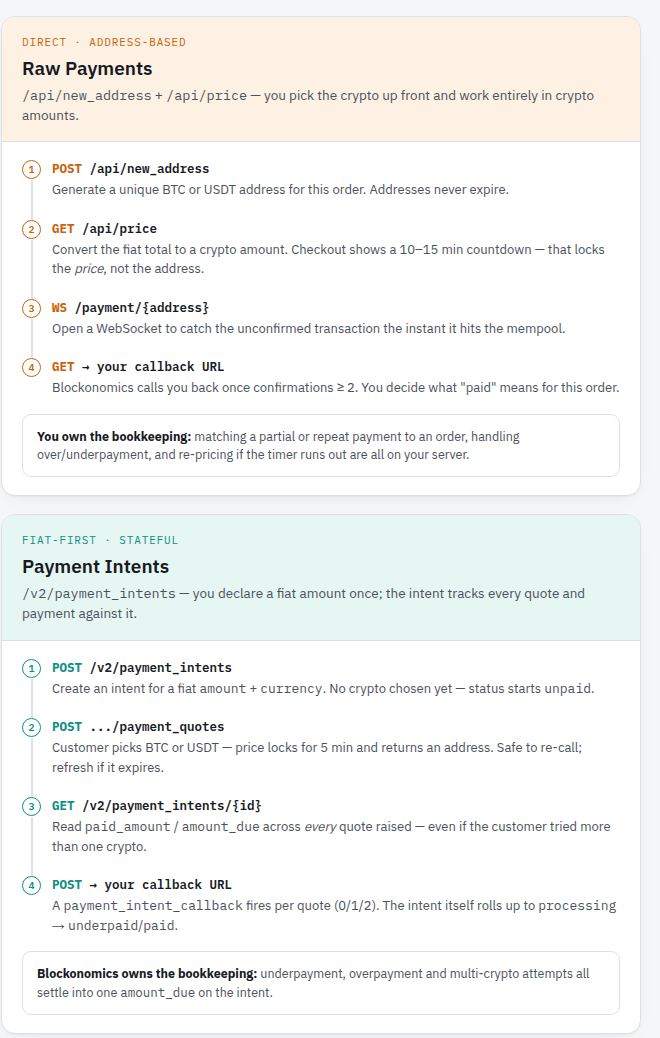
Blockonomics already has raw payment API that enables merchants to create unique addresses for each order and get callbacks for payments. However, implementing this for each coin becomes cumbersome when we have large number of coins. The merchant also has to implement logic to lock/refresh the crypto price and store crypto address amounts along with each order. While this is necessary for special workflow like exchanges, most merchants have a standard order/checkout flow that need not delve into this crypto complexity.
What is a PaymentIntent
In a nutshell, a payment intent is a construct to collect payment from customer. For example, if a shopping cart has the following items:
1 x Oak Table - 500USD
4 x Chairs - 400USD
Then the merchant site will create a payment intent to collect 900USD from the customer. Customer can pay this total 900USD using multiple cryptos like BTC, USDT. A PaymentIntent can be in unpaid, processing, paid or underpaid status.
Comparison
| Parameter | Raw payments (address-based) | Payment Intents API |
|---|---|---|
| Core unit | A receiving address per payment | A payment intent object per order (pi_…) |
| Rate handling | Fetch price and calculate crypto amount manually | Quote generated by the API with a rate lock (5 min in this app) |
| Payment UI | Build address display, QR code, amount, and countdown yourself | Hosted pay_url, or use the public Payer API for a custom UI |
| Crypto support | Wire up each coin separately | BTC and USDT handled under one intent flow |
| Payment monitoring & status | Poll address transactions and parse raw chain events yourself | Blockonomics tracks confirmations and exposes named states (processing, underpaid, paid) |
| Callback trust | Per-address callback; match payload to the order manually | Store-level callback with intent id; re-fetch the intent before trusting status |
| Fulfilment safety | Implement your own dedupe and reconciliation guard | Re-fetch the intent, then fulfil once using the intent id |
Inbuilt Agentic Payment Support
Agents like muse are now able to browse and intiate checkout on any website. However, using UX designed for humans throttles agents abilities. With an API/MCP support, agents can do powerful things like purchase a bookshelf with price <50USD matching the color theme of the this room. PaymentIntents API has default support for agentic checkout. Below is a sample llms.txt on a bookshop that enable agents to discover products and pay via the PaymentIntent pay endpoint.
Gallery
A sample checkout UX using payment Intents API
References
All information about PaymentIntents API can be found in our reference documentation https://developers.blockonomics.co/docs/guides/receiving-payments